
 Shepherd
On Site Daily Flat
Flat
Per-Acre Quote Zero
Zero
Herbicide Solar
Solar
Electric Fence Daily Goat-Cam
Texts
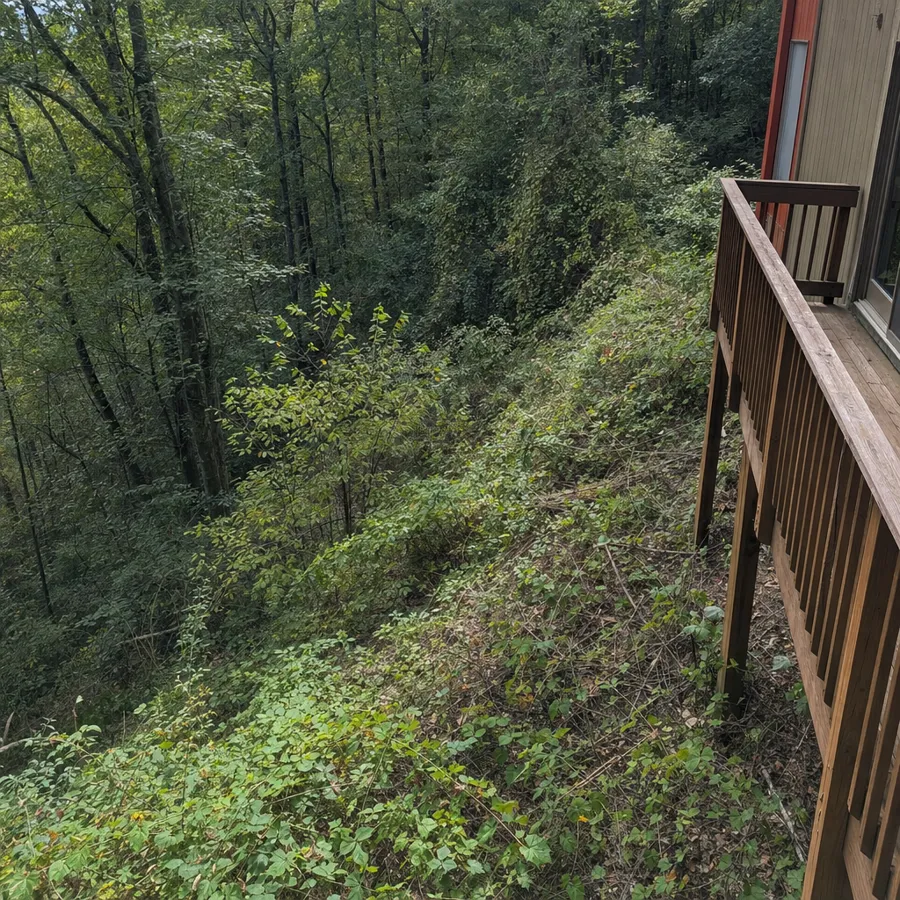
Some slopes weren't built for mowers.
 Too steep for a mower to stay upright
 A trimmer on a grade is a fall risk
 Machine clearing leaves soil bare to wash
Goats were built for exactly this hill.
Meet your steep slope specialist


Biscuit
Slope Compliance Officer
“Biscuit has never met a grade he didn't consider flat. He files his reports from the top.”

20 to 40goats per job
About 1/4acre per day

0 gallonsof herbicide
The Goat Squad Method
- 1
 Free
Free
walk-throughWe walk the land with you - 2Flat
per-acre quoteIn writing, before the gate opens - 3
 Fence up,
goats inShepherd on site every day - 4Daily
goat-cam textsWatch the slope clear itself
What steep slope clearing includes
- Walk-through and flat per-acre quote
- Solar electric fence set along the slope
- Shepherd on site every day
- Daily goat-cam photos by text
- Fence-out of plantings, walls and wet spots
- Optional follow-up graze for regrowth
Day 1 vs Day 5
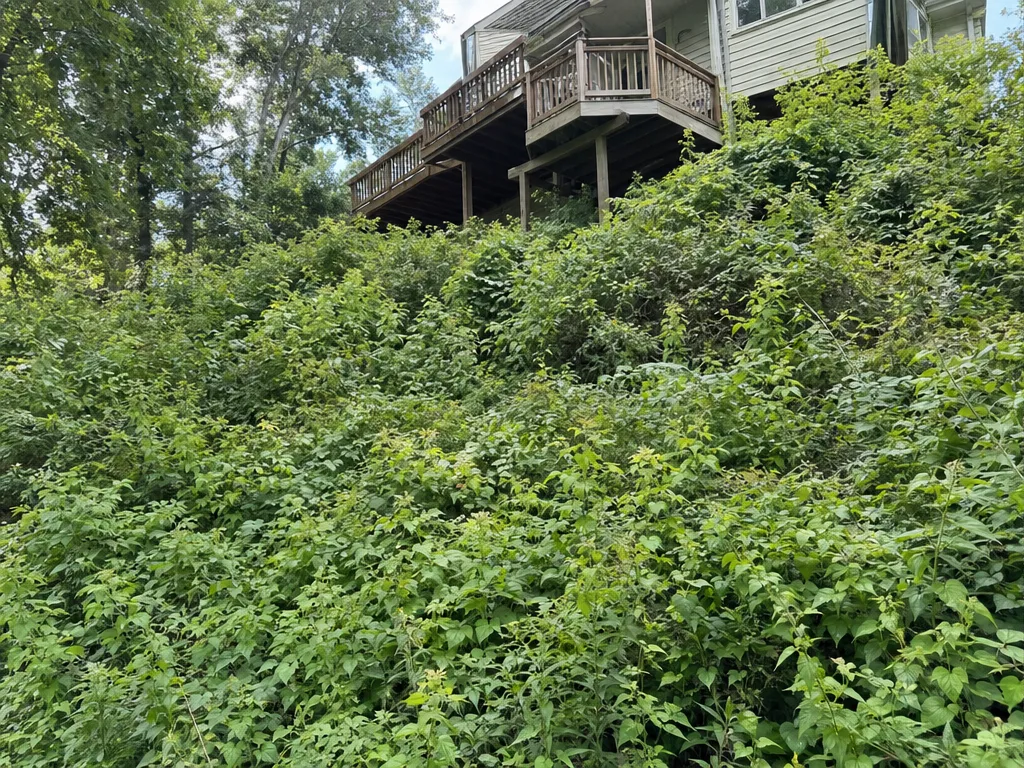 Day 1
Day 1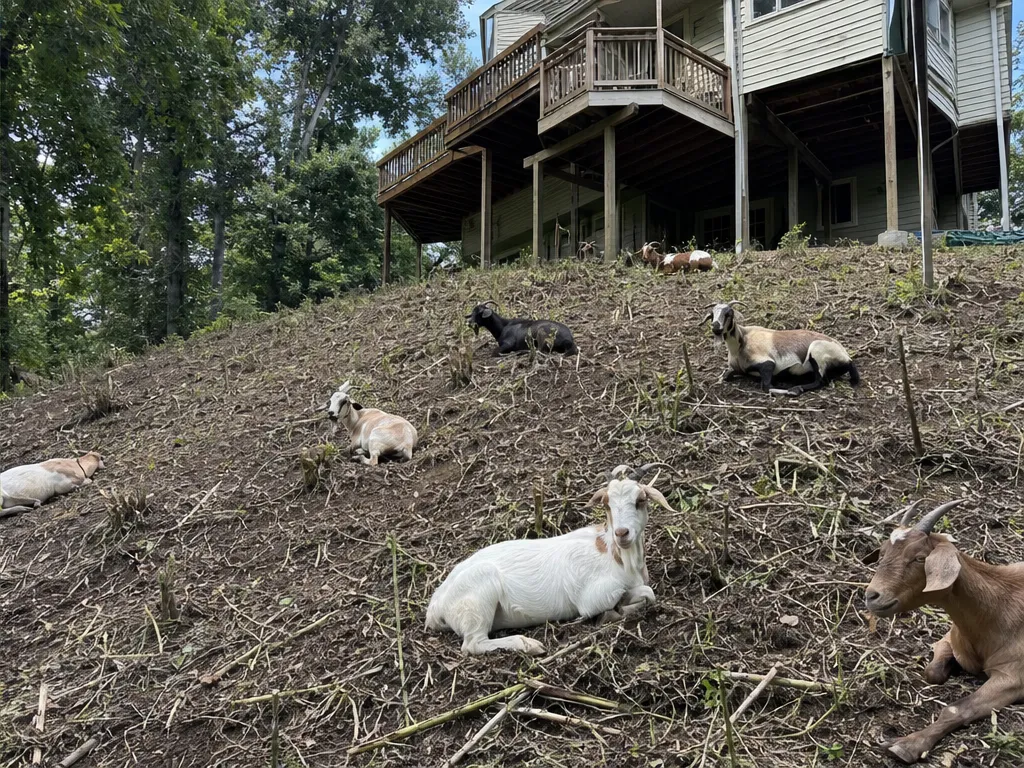 Day 5
Day 5How goats clear a steep slope
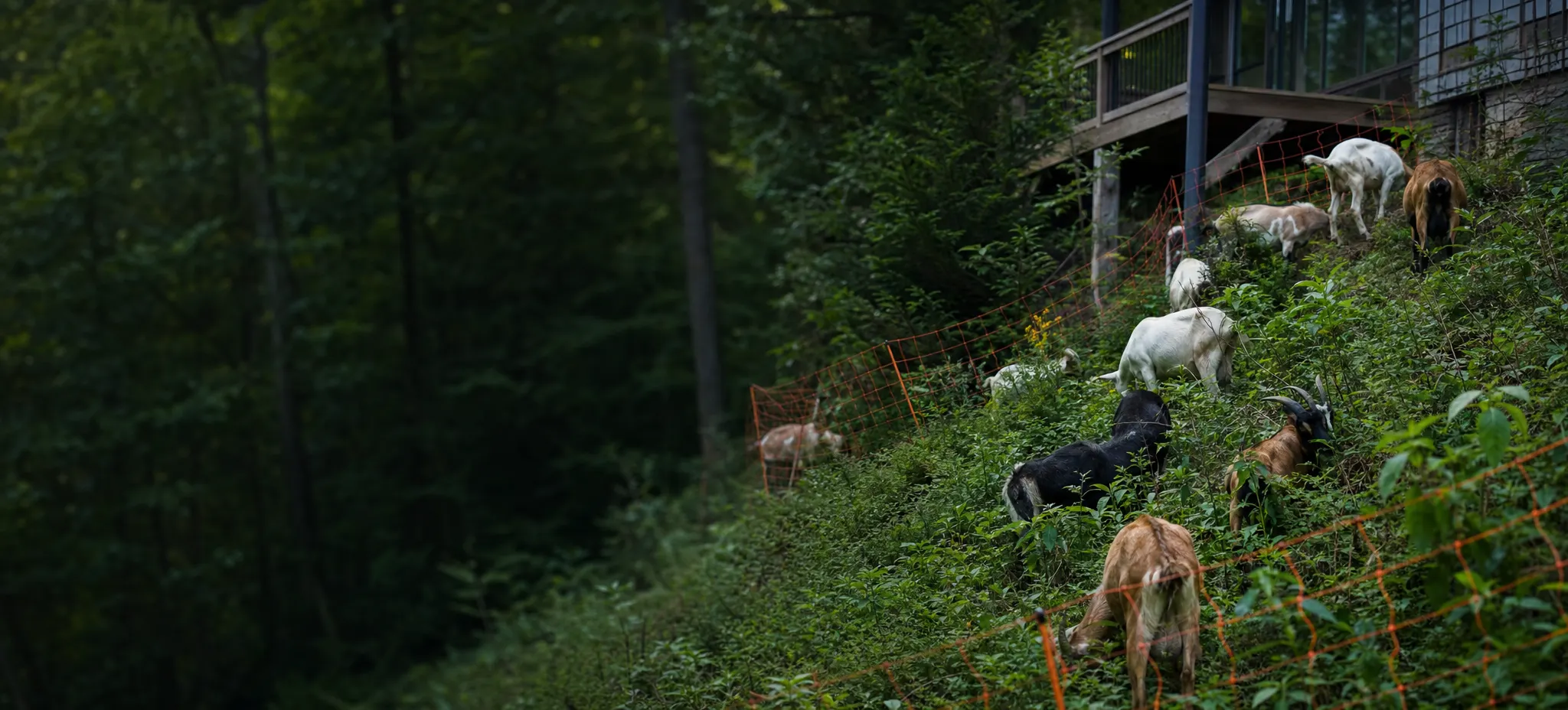
Goats are browsers with split hooves and a low center of gravity, and they're comfortable on ground where people have to use their hands. On a slope job, the herd works inside a portable solar electric fence that we set along the contours of the hill. They eat brush, brambles, vines and saplings from the bottom of the plants up, and they reach about six feet high standing on their hind legs.
A herd of about 30 goats typically clears around a quarter acre a day. Slope itself doesn't slow them down much. Density does. A bank of thick blackberry and multiflora rose takes longer than a slope of tall weeds and honeysuckle. On a big hillside, we move the fence in sections so the herd finishes one strip before starting the next.
Nobody has to climb the hill with a trimmer, a chainsaw or a backpack sprayer. The shepherd walks the fence line and keeps an eye on the herd. The goats do the part that's hard on knees.
Goats vs. mowers vs. brush crews on a slope
| Compared on | Goats | Mowers and machines | Hand crews with trimmers |
|---|---|---|---|
| Steep grades | Built for it | Rollover and sliding risk | Slow, with fall and cut risk |
| Roots and soil | Roots left in place | Tracks and blades can tear up the surface | Roots mostly left in place |
| Rocks, stumps, hidden holes | Walk around them | Can damage equipment or throw debris | Hard on blades and ankles |
| What's left behind | Low stems and fertilizer | Shredded debris or bare ground | Piles of cuttings to haul uphill |
| Herbicide | None | Often paired with spraying | Sometimes paired with spraying |
The honest summary: on a gentle, open yard, a mower is faster and cheaper to run. Goats earn their spot where the ground tilts, the brush is thick, or nobody wants to be the person standing on it.
Why roots matter on a mountain lot
On a slope, the roots of the brush you want gone are also what's holding the dirt in place. Grading or grubbing a hillside clears it fast, but it leaves bare soil, and in a heavy mountain rain bare soil moves. It ends up in your driveway, your neighbor's yard or the nearest creek.
Goats only eat what's above ground. The root systems stay where they are and keep binding the soil while new, lower growth fills back in. The herd also leaves behind a steady supply of fertilizer, which helps whatever you plant next get established.
Two honest caveats from the shepherd:
- Hooves can scuff wet, bare ground. On soft spots or after heavy rain, we move the fence or give that section a rest so the herd doesn't churn it.
- Grazing isn't slope repair. If a hillside is already slumping, cracking or undercutting a wall, that's a job for a geotechnical engineer, not a goat. We'll say so at the walk-through.
If you're planning to replant with natives or a groundcover, right after the goats is a good window. You can see the ground, and there's nothing left to compete with. Follow-up grazes, if you want them, are quoted separately. You can see how our quotes work in the goat grazing cost guide.
What the goats can and can't do on a slope
What they're good at
- Brush, brambles, vines, weeds and small saplings
- Poison ivy, kudzu, multiflora rose and honeysuckle on banks nobody wants to stand on
- Clearing sightlines and making a hillside walkable again
What they don't do
- Tree removal and stumps. Goats will strip low branches and bark, but they don't fell trees or grind stumps.
- Retaining walls, drainage or grading. We clear the brush so the right contractor can see what they're working with.
- Toxic ornamentals. Rhododendron and mountain laurel grow all over these hillsides and are toxic to goats. We fence them out or skip that section, and the shepherd checks for them before the gate opens.
Where steep slopes need goats around Asheville
Asheville is built on hills, and a lot of houses sit on lots that drop away fast behind the deck. We see steep, overgrown backyards in West Asheville and around the neighborhoods north of downtown, long banks above driveways in Fairview and Black Mountain, and wooded hillsides in Arden, Candler and Leicester where the back half of the property hasn't been touched in years.
Creek and river banks are another common job. Slopes that drain toward the French Broad and Swannanoa rivers are exactly where you want the roots left in the ground and the herbicide left in the shed. The same goes for the steep, wooded lots along the Blue Ridge Parkway corridor, where the view is the whole point of the property.
Not sure your slope is a goat job? Book a free walk-through. The shepherd will check footing, fence access and plant list, then give you a flat per-acre quote.
Steep slope questions
How steep is too steep for goats?
Goats are comfortable on grades that are hard for people to walk, so the slope itself is rarely the limit. What we check at the walk-through is footing, access for the fence and whether there's anything unstable. If a spot isn't safe for the herd, we'll tell you.
Will goats cause erosion on my slope?
Much less than machines. Goats eat the growth above ground and leave the roots holding the soil. On wet or bare patches the shepherd rotates the herd so hooves don't churn the ground.
What happens to all the brush?
Most of it gets eaten. What's left is low, woody stems and a layer of fertilizer, so there are no piles to drag up the hill or haul away. Larger woody stems can be cut afterward if you want the slope fully open.
Do I need to be home while the goats work?
No. The shepherd is on site every day the herd is on your property, handling water, fence checks and headcounts. You'll get daily goat-cam photos by text either way.